Slide background
cem4

certifico machinery regulation


The best software solution for Machinery Regulation

Download CEM4 free trial 30 days

Slide background


Organizza al meglio il Tuo lavoro sulla Direttiva macchine

Prova il nuovo Metodo di Valutazione dei Rischi EN ISO 12100 della Versione 2017

Download CEM4 full gratuita 30 giorni

Slide background

cem4 | certifico machinery regulation

Organizza al meglio il Tuo lavoro sul nuovo Regolamento macchine

Prova il metodo di Valutazione dei Rischi EN ISO 12100

Download CEM4 full gratuita 30 giorni

Slide background


Organizza al meglio il Tuo lavoro sulla Direttiva / Regolamento macchine

Prova il nuovo Metodo di Valutazione dei Rischi EN ISO 12100

Download CEM4 full gratuita 30 giorni

Slide background


Organizza al meglio il Tuo lavoro sulla Direttiva macchine

Prova il nuovo Metodo di Valutazione dei Rischi EN ISO 12100 della Versione 2017

Download CEM4 full gratuita 30 giorni

cem4 | News

Regolamento macchine / Regolamento (UE) 2023/1230 / Consolidato Luglio 2026

Regolamento macchine / Regolamento (UE) 2023/1230 / Consolidato Luglio 2026

Disponibile in formato pdf /epub navigabile e stampabile/copiabile il testo consolidato 2026 del Regolamento (UE) 2023/1230 del Parlamento europeo e del Consiglio del 14 giugno 2023 relativo alle macchine e che abroga la direttiva 2006/42/CE del Parlamento euroeo e del Consiglio e la direttiva 73/361/CEE del Consiglio (GU n. 165/1 del 29.06.2023)

Download Indice Ed. 4.0 2026

Vedi testo consolidato Ed. 4.0 Luglio 2026

  • Pubblicato: 24 Luglio 2026
  • Visite: 2386

Recommendation for use (RfU) sheets / Machinery Regulation (EU) 2023/1230 / EC May 2026

Recommendation for use  RfU  sheets   Machinery Regulation  EU  2023 1230   EC May 2026

Recommendation for use (RfU) sheets / Machinery Regulation (EU) 2023/1230 / EC May 2026

The following 'recommendation for use' sheets reflect the common position of the notified bodies in the machinery sector.

They assist notified bodies in their tasks with the conformity assessment of machinery, as linked to the EU type-examination procedure, and in accordance with the terms of the machinery legislation.

All stakeholders involved in implementing this legislation are encouraged to use this helpful information.
_______

Horizontal RfU sheets are prefixed by 00 and apply to all types of machinery listed in Annex I of the Machinery Regulation

- Horizontal RfUs concerning Machinery Regulation (EU) 2023/1230 / May 2026 (Attached)

Vertical RfU sheets apply more specifically to a particular category of machinery listed in Annex I of the Machinery Regulation

For example, sheets prefixed by 01 deal with woodworking machinery, and sheets prefixed by 04 deal with injection or compression moulding machines.

- Vertical RfUs concerning Machinery Regulation (EU) 2023/1230 / May 2026 (Attached)

[...]

Fonte: CE

Add more

  • Pubblicato: 27 Giugno 2026
  • Visite: 12119

ISO 6909:2026 / Press brakes safety

ISO 6909 2026    Press brakes safety

ISO 6909:2026 /  Press brakes safety

ISO 6909:2026
Machine tools - Safety - Press brakes

This document specifies technical safety requirements and measures to be adopted by persons undertaking the design, manufacture and supply of press brakes which are intended to work cold metal or material partly of cold metal but which can be used in the same way to work other sheet materials (e.g. cardboard, plastic, rubber, leather) and also referred to as machines. 

NOTE 1 The design of a machine includes the study of the machine itself, taking into account all phases of the “life” of the machine mentioned in ISO 12100:2010, 5.4, and the drafting of the instructions related to all the above phases.

This document covers the following types of machines (see Annex J): hydraulic press brakes; hydraulic servo-drive press brakes; screw servo-drive press brakes; belt-spring servo-drive press brakes. The requirements in this document take account of intended use, as defined in ISO 12100:2010, 3.23, as well as reasonably foreseeable misuse, as defined in ISO 12100:2010, 3.24. This document presumes access to the press brake from all directions, deals with all significant hazards during the various phases of the life of the machine described in Clause 4, and specifies the safety measures for both the operator and other exposed persons. 

NOTE 2 All significant hazards means those identified or associated with press brakes at the time of the publication of this document. 

This document can also be used as a guide for the design of press brakes which are intended to be integrated in a manufacturing system. 

This document deals with all significant hazards, hazardous situations or hazardous events relevant to press brakes and ancillary devices (see Clause 4) when it is used as intended and under conditions of misuse which are reasonably foreseeable by the manufacturer. This document specifies the safety requirements for press brakes defined in Clause 3. 

This document does not cover press brakes which transmit energy to impart beam motion by using pneumatic means or mechanical clutch or press brakes that use combination of technologies (e.g. combined hydraulic and screw servo-drive press brake or combined hydraulic servo-drive and screw servo-drive press brake). 

This document does not cover machines whose principal designed purpose is: sheet folding by rotary action; tube and pipe bending by rotary action; roll bending. This document does not cover hazards related to the use of press brakes in explosive atmospheres.

This document is not applicable to press brakes which are manufactured before the date of its publication.

This document does not cover the safety aspect of equipment for automatic workpiece loading and unloading where provided. Guidance on how to take into account additional automatic loading and unloading equipment can be found in ISO 11161:2007.

[box-info]This document is a type C standard as stated in ISO 12100:2010. This document is of relevance, in particular, for the following stakeholder groups representing the market players with regard to machinery safety: — machine manufacturers (small, medium and large enterprises); — health and safety bodies (regulators, accident prevention organizations, market surveillance etc.).

Others can be affected by the level of machinery safety achieved with the means of the document by the above-mentioned stakeholder groups: 

- machine users/employers (small, medium and large enterprises); 
- machine users/employees (e.g. trade unions, organizations for people with special needs); 
- service providers, for example, for maintenance (small, medium and large enterprises); 
- consumers (in the case of machinery intended for use by consumers). 

The above-mentioned stakeholder groups have been given the possibility to participate at the drafting process of this document. 

The machinery concerned and the extent to which hazards, hazardous situations or hazardous events are covered are indicated in the Scope of this document. When requirements of this type-C standard are different from those which are stated in type-A or type-B standards, the requirements of this type-C standard take precedence over the requirements of the other standards for machines that have been designed and built according to the requirements of this type-C standard.
...

See Preview

  • Pubblicato: 31 Maggio 2026
  • Visite: 21384

Passaggio Direttiva macchine al Regolamento macchine: le cose da fare / Elaborato Certifico AI

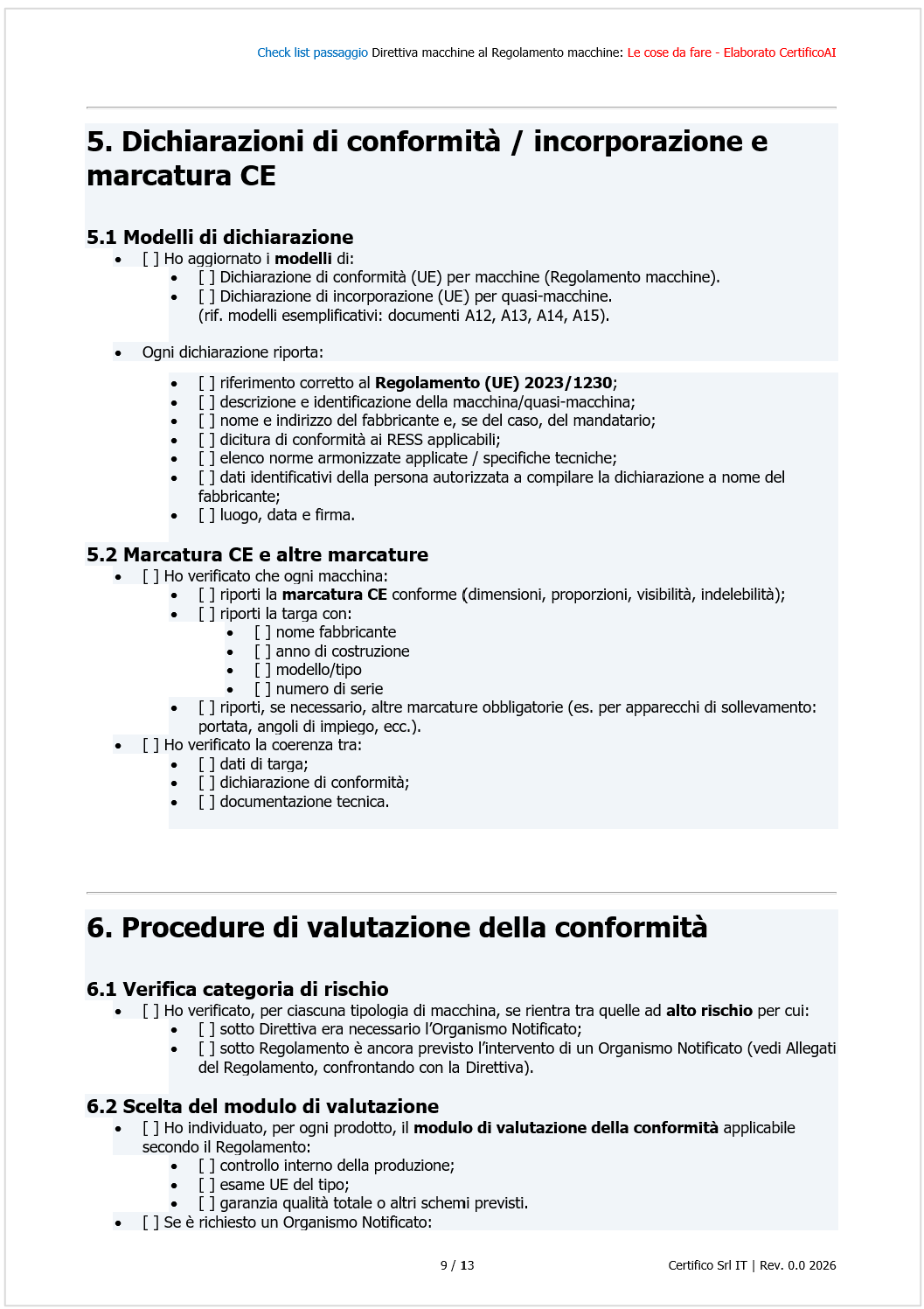
Check list passaggio Direttiva al Regolamento Macchine

Passaggio Direttiva macchine al Regolamento macchine: le cose da fare / Elaborato Certifico AI

Download allegato

Elaborato con Certifico AI, un Documento, testo e check list per le cose da fare per il passaggio dalla Direttiva macchine al Regolamento macchine. Prompt riportati nel documento (elaborato base), fonti consultate AI riportate in calce.
__________

Fig  1   Check list passaggio Direttiva al Regolamento Macchine

Certifico AI / Versione Professional

Vedi Documento

  • Pubblicato: 08 Maggio 2026
  • Visite: 26550

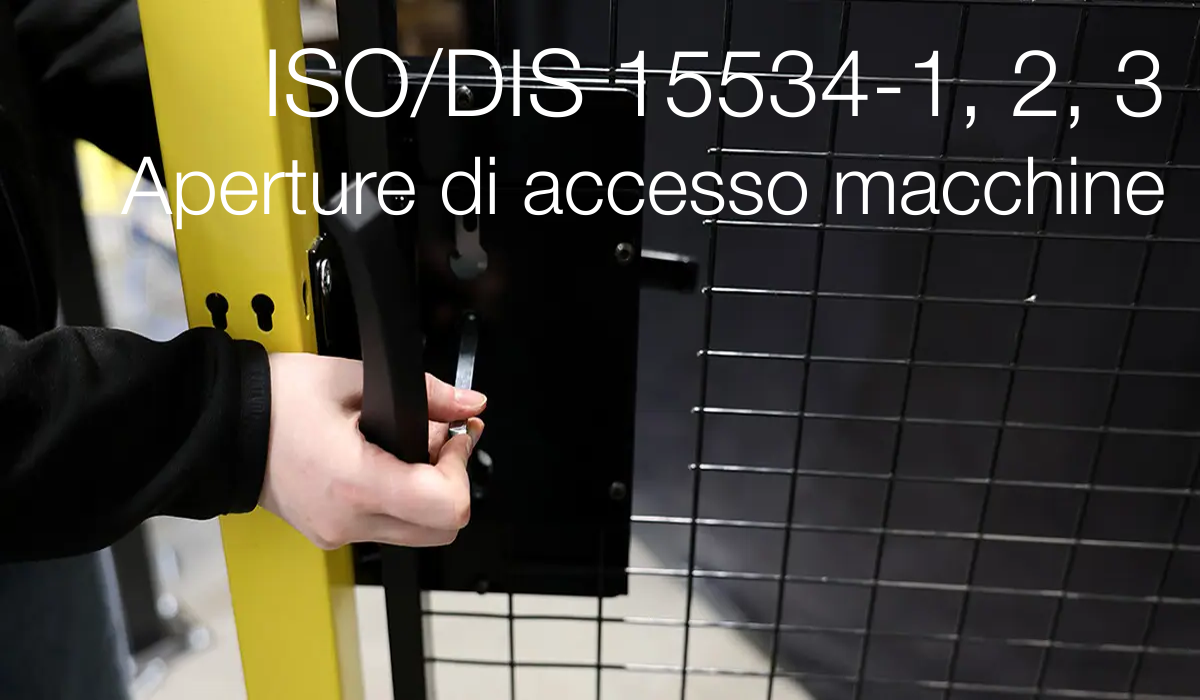
ISO/DIS 15534-1, 2, 3 / Aperture di accesso nelle macchine

ISO DIS 15534 1  2  3

ISO/DIS 15534-1, 2, 3 / Aperture di accesso nelle macchine

In revisione 3 norme ISO relative all'ergonomia di macchine, in particolare delle aperture di accesso: ISO 15534-1:2000, ISO 15534-2:2000 e ISO 15534-3:2000.

Si tratta della seconda edizione delle 3 norme (stato data news DIS) che annulla e sostituisce la prima edizione e che ne costituisce una revisione tecnica.
________

La norma ISO 15534 è composta dalle seguenti parti, sotto il titolo generale Progettazione ergonomica per la sicurezza dei macchinari:

- Parte 1: Principi per la determinazione delle dimensioni necessarie per le aperture di accesso con tutto il corpo nei macchinari
- Parte 2: Principi per la determinazione delle dimensioni necessarie per le aperture di accesso
- Parte 3: Dati antropometrici

[...]

Maggiori info

  • Pubblicato: 06 Aprile 2026
  • Visite: 26619

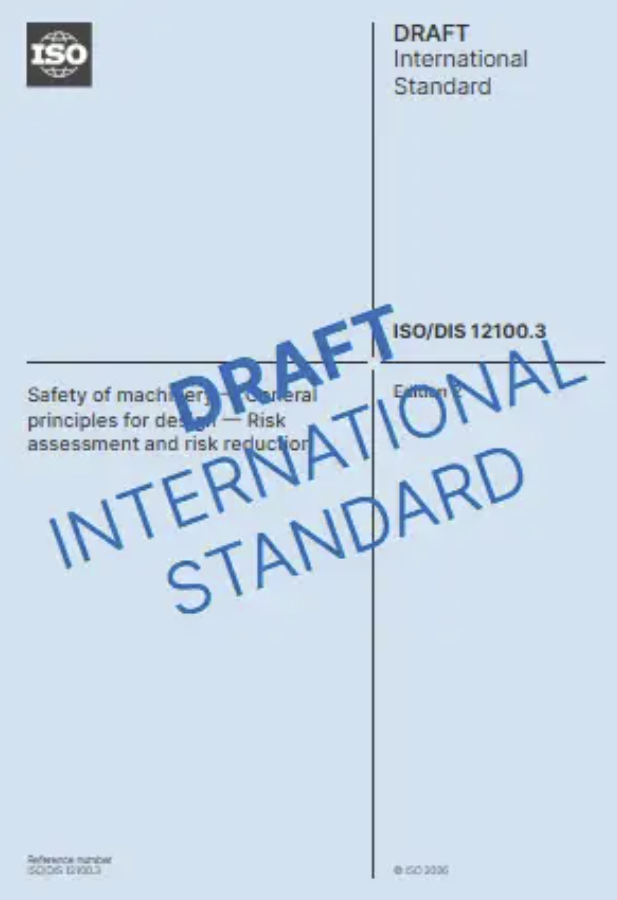
ISO/DIS 12100.3 / DIS ballot initiated 20.07.2026

ISO DIS 12100 3

ISO/DIS 12100.3 / DIS ballot initiated 20.07.2026

ISO/DIS 12100.3
Safety of machinery - General principles for design - Risk assessment and risk reduction

Status: Under development
Stage: DIS ballot initiated: 12 weeks [40.20] 20.07.2026
Edition: 2
Number of pages: 94

This Draft International Standard is in the enquiry phase with ISO members.

ISO 12100:2010 specifies basic terminology, principles and a methodology for achieving safety in the design of machinery.

It specifies principles of risk assessment and risk reduction to help designers in achieving this objective. These principles are based on knowledge and experience of the design, use, incidents, accidents and risks associated with machinery. Procedures are described for identifying hazards and estimating and evaluating risks during relevant phases of the machine life cycle, and for the elimination of hazards or sufficient risk reduction. Guidance is given on the documentation and verification of the risk assessment and risk reduction process.

ISO 12100:2010 is also intended to be used as a basis for the preparation of type-B or type-C safety standards.

It does not deal with risk and/or damage to domestic animals, property or the environment.
_______

Life cycle 20.07.2026

_______

Preview ISO/DIS 12100.3
Safety of machinery - General principles for design - Risk assessment and risk reduction

Foreword

ISO (the International Organization for Standardization) is a worldwide federation of national standards bodies (ISO member bodies). The work of preparing International Standards is normally carried out through ISO technical committees. Each member body interested in a subject for which a technical committee has been established has the right to be represented on that committee. International organizations, governmental and non-governmental, in liaison with ISO, also take part in the work. ISO collaborates closely with the International Electrotechnical Commission (IEC) on all matters of electrotechnical standardization.

The procedures used to develop this document and those intended for its further maintenance are described in the ISO/IEC Directives, Part 1. In particular, the different approval criteria needed for the different types of ISO document should be noted. This document was drafted in accordance with the editorial rules of the ISO/IEC Directives, Part 2 (see www.iso.org/directives).

ISO draws attention to the possibility that the implementation of this document may involve the use of (a) patent(s). ISO takes no position concerning the evidence, validity or applicability of any claimed patent rights in respect thereof. As of the date of publication of this document, ISO had not received notice of (a) patent(s) which may be required to implement this document. However, implementers are cautioned that this may not represent the latest information, which may be obtained from the patent database available at www.iso.org/patents. ISO shall not be held responsible for identifying any or all such patent rights.

Any trade name used in this document is information given for the convenience of users and does not constitute an endorsement.

For an explanation of the voluntary nature of standards, the meaning of ISO specific terms and expressions related to conformity assessment, as well as information about ISO's adherence to the World Trade Organization (WTO) principles in the Technical Barriers to Trade (TBT), see www.iso.org/iso/foreword.html.

This document was prepared by Technical Committee ISO/TC 199, Safety of machinery, in collaboration with the European Committee for Standardization (CEN) Technical Committee CEN/TC 114, Safety of machinery, in accordance with the Agreement on technical cooperation between ISO and CEN (Vienna Agreement).

This second edition of ISO 12100 cancels and replaces ISO 12100:2010, ISO/TR 22100-1:2021 and ISO/TR 22100-2:2013.

The main changes are as follows:

- the Scope has been modified;
- additional normative references were added to Clause 2;
- terms and definitions have been modified in Clause 3;
- new Figure 1 added, and Figure 4 from previous edition deleted;
- requirements for control systems moved to 6.3.5;
- reference to self-evolving behaviour of applied artificial intelligence added to 5.4.3, b) 7);
- new subclause “Hygiene aspects” added as 6.2.14;
- subclause “Safeguarding to reduce emissions” shortened on general aspects only;
- subclause on “Software aspects” completely rewritten;
- updates made to requirements for guards and protective devices (6.3.2);
- new subclauses “Indirect control” and “Remote software updates” added as 6.3.5.11 and 6.3.5.12, respectively;
- new subclause “Cybersecurity and protection against corruption” added as 6.3.5.17;
- ISO/TR 22100-1 and ISO/TR 22100-2 incorporated as new Annexes C and D.

In addition to text written in the official ISO languages (English, French, Russian), this document gives text in German. This text is published under the responsibility of the member body for Germany (DIN) and is given for information only. Only the text given in the official languages can be considered as ISO text. Any feedback or questions on this document should be directed to the user’s national standards body. A complete listing of these bodies can be found at www.iso.org/members.html.

Introduction

The primary purpose of this document is to provide designers with an overall framework and guidance for decisions during the development of machinery to enable them to design machines that are adequately safe for their intended use. It also provides a strategy for standards developers and will assist in the preparation of consistent and appropriate type-B and type-C standards.

The concept of safety of machinery considers the ability of a machine to perform its intended function(s) during its lifecycle where risk has been adequately reduced.

This document is the basis for a set of standards which has the following structure:

  1. a) type-A standards (basic safety standards) giving basic concepts, principles for design, and general aspects that can be applied to all machinery;
    b) type-B standards (generic safety standards) dealing with one safety aspect or one or more type(s) of safeguard that can be used across a wide range of machinery:
    - type-B1 standards on particular safety aspects (e.g. safety distances, surface temperature, noise);
    - type-B2 standards on safeguards (e.g. two-hand control devices, interlocking devices, pressure-sensitive devices, guards);
    c) type-C standards (machine safety standards) dealing with detailed safety requirements for a particular machine or group of machines.

This document is a type-A standard.

This document is of relevance, in particular, for the following stakeholder groups representing the market players with regard to machinery safety:

- machine manufacturers (small, medium and large enterprises);
- health and safety bodies (regulators, accident prevention organizations, market surveillance);

Others can be affected by the level of machinery safety achieved with the means of the document by the above-mentioned stakeholder groups:

- machine users/employers (small, medium and large enterprises);
- machine users/employees (e.g. trade unions, organizations for people with special needs);
- service providers, e.g. for maintenance (small, medium and large enterprises);
- consumers (in case of machinery intended for use by consumers).

The above-mentioned stakeholder groups have been given the possibility to participate in the drafting process of this document.

When a type-C standard deviates from one or more technical provisions dealt with by this document or by a type-B standard, the type-C standard takes precedence.

It is desirable that this document be referred to in training courses and manuals to convey basic terminology and general design methods to designers.

ISO/IEC Guide 51 has been taken into account as far as practicable at the time of drafting of this document.

A trilingual lookup and index of specific terms and expressions used in this document is given in Annex E.

1 Scope

This document defines basic terminology and specifies principles and a methodology for safety in the design of machinery. It specifies principles of risk assessment and risk reduction to help designers in achieving this objective. These principles are based on knowledge and experience of the design, use, incidents, accidents and risks associated with machinery. Procedures are described for identifying hazards and estimating and evaluating risks during relevant phases of the machine lifecycle, and for the elimination of hazards or the provision of adequate risk reduction. Guidance is given on the documentation and verification of the risk assessment and risk reduction process.

This document covers principal implications on machinery safety in case of implementation of artificial intelligence/machine learning, and vulnerability to cyber threats and data corruption regarding their impact on safety. It specifies generic measures to address both aspects.

Safety of machinery includes hygiene aspects.

This document is also intended to be used as a basis for the preparation of type-B or type-C safety standards.

This document covers neither risk nor damage to domestic animals, property or the environment.

NOTE 1 While this document refers to risks of harm to persons, the risk assessment process set out in this document can be equally effective in assessing other types of risks such as damage to domestic animals, property or the environment.

NOTE 2 Annex B gives, in separate tables, examples of hazards, hazardous situations and hazardous events, in order to clarify these concepts and assist the designer in the process of hazard identification.

NOTE 3 The practical use of a number of methods for each stage of risk assessment is described in ISO/TR 14121-2.

NOTE 4 As used in this document, the designer of a machine can include the manufacturer, integrator, supplier, or the user in case of safety-relevant modifications.

NOTE 5 This document can also be used for existing machinery.

2 Normative referencesThe following documents are referred to in the text in such a way that some or all of their content constitutes requirements of this document. For dated references, only the edition cited applies. For undated references, the latest edition of the reference document (including any amendments) applies.

ISO/DIS 12895-2:2025 Safety of machinery - Identification of whole body access and prevention of associated risk(s)

ISO 13849-1:2023 Safety of machinery - Safety-related parts of control systems - Part 1: General principles for design

ISO 20607 Safety of machinery - Instruction handbook - General drafting principles

3 Terms and definitionsFor the purposes of this document, the following terms and definitions apply.

ISO and IEC maintain terminology databases for use in standardization at the following addresses:

- ISO Online browsing platform: available at https://www.iso.org/obp

- IEC Electropedia: available at https://www.electropedia.org/

3.1

machinery

machine

assembly, fitted with or intended to be fitted with a drive system other than directly applied human or animal effort, consisting of linked parts or components, at least one of which moves, and which are joined together for a specific application

Note 1 to entry: The term “machinery” can include an assembly of machines, which achieves the same purpose, when they are arranged and controlled to function as an integral whole.

Note 2 to entry: Annex A provides a general schematic representation of a machine.

3.2

reliability

ability of a machine or its components or equipment to perform a required function under specified conditions and for a given period of time without failing

3.3

maintainability

characteristic of a machine that allows it to be kept in a state which enables it to fulfil its function under conditions of intended use, or to be restored to such a state

3.4

usability

characteristic of a machine that allows it to be easily used including properties or characteristics that enable its function(s) to be easily understood

3.5

harm

physical injury or damage to health

3.6

hazard

potential source of harm

Note 1 to entry: The term “hazard” can be qualified in order to define its origin (e.g. mechanical hazard, electrical hazard) or the nature of the potential harm (e.g. electric shock hazard, cutting hazard, toxic hazard, fire hazard).

Note 2 to entry: The hazard envisaged by this definition either:

- is permanently present during the intended use of the machine (e.g. motion of hazardous moving elements, electric arc during a welding phase, unhealthy posture, noise emission, high temperature); or

- can appear unexpectedly (e.g. explosion, crushing hazard as a consequence of an unintended/unexpected start-up, ejection as a consequence of a breakage, fall as a consequence of acceleration/deceleration).

3.7

significant hazard

hazard which has been identified as associated with the machine and which requires specific action to eliminate or to reduce its risk in accordance with the risk assessment

Note 1 to entry: This term is included as basic terminology for type-B and type-C standards.

Note 2 to entry: The prior term "relevant hazard" is included as being a significant hazard.

3.8

hazardous event

event that can cause harm

Note 1 to entry: A hazardous event can occur over a short period of time or over an extended period of time.

3.9

hazardous situation

circumstance in which a person is exposed to at least one hazard

Note 1 to entry: The exposure can result in harm immediately or over a period of time.

3.10

hazard zone

danger zone

any space either within or around machinery, or both, in which a person can be exposed to a hazard

3.11

risk

combination of the probability of occurrence of harm and the severity of that harm

3.12

residual risk

risk remaining after risk reduction measures have been implemented

Note 1 to entry: This document distinguishes:

- the residual risk after risk reduction measures have been implemented by the designer;

- the residual risk remaining after all risk reduction measures by the designer and the user have been implemented.

Note 2 to entry: See also Figure 3.

3.13

risk estimation

defining likely severity of harm and probability of its occurrence

3.14

risk analysis

combination of the specification of the limits of the machine, hazard identification and risk estimation

3.15

risk evaluation

procedure based on the risk analysis to determine whether further risk reduction is required

[SOURCE: ISO/IEC Guide 51:2014, 3.12, modified - The wording “tolerable risk has been exceeded” has been replaced with “further risk reduction is required”.]

3.16

risk assessment

overall process comprising a risk analysis and a risk evaluation

Note 1 to entry: See Figure 1.

3.17

risk reduction measure

DEPRECATED:protective measure

action or means to eliminate hazards or reduce risks

Note 1 to entry: See Figure 2 and Figure 3.

3.18

complementary risk reduction measure

risk reduction measure used in conjunction with inherently safe design, safeguarding or information for use to enhance risk reduction

3.19

tolerable risk

acceptable risk

adequately reduced risk

level of risk that is accepted in a given context based on the current values of society at a minimum in accordance with legal requirements

Note 1 to entry: Tolerable risk usually refers to the level at which further technologically, functionally and financially feasible risk reduction measures or additional expenditure(s) of resources will not result in significant reduction in risk.

Note 2 to entry: Criteria for determining when adequately reduced risk is achieved are given in 5.6.2.
...
_______

Fonte: ISO

Add more

  • Pubblicato: 21 Luglio 2026
  • Visite: 3544

CEM4 June 2026 Update

cem4 June 2026

CEM4 Juner 2026 Update / Rev. 7 Machinery Regulation (EU) 2023/1230

09 Giugno 2026

Novità importante:

nuova funzione di "Esporta tutto" con unione in un unico file di report PDF elaborati dal software con selezione predefinita o personalizzata.

Home macchina / Stampa unione / Esporta tutto (PDF unico)

  • Pubblicato: 09 Giugno 2026
  • Visite: 18389

Decision C(2025)129 of 20.1.2025 - Mandate M/605 (Standards for Machinery Regulation)

Mandate M 605  Standards for Machinery Regulation

Decision C(2025)129 of 20.1.2025 - Mandate M/605 (Standards for Machinery Regulation)

Commission implementing decision of 20.1.2025 on a standardisation request to the European Committee for Standardization and to the European Committee for Electrotechnical Standardization as regards machinery and related products in support of Regulation (EU) 2023/1230 of the European Parliament and of the Council.
__________

Article 1 Requested standardisation activities

1. The European Committee for Standardization (‘CEN’) and the European Committee for Electrotechnical Standardization (‘CENELEC’) are requested to draft new harmonised standards and European standardisation deliverables listed in Table 1 of
Annex I to this Decision and to amend or revise the existing harmonised standards and European standardisation deliverables listed in Table 2 of Annex I to this Decision, in support of Regulation (EU) 2023/1230, for machinery, related products and partly completed machinery by the deadlines set out in that Annex.

2. If CEN and CENELEC do not amend or revise the harmonised standards referred to in Annex I to Commission Implementing Decision (EU) 2023/1586, they shall, by 20 January 2026, inform the Commission of the references of those standards and, where relevant, of the reasons why their amendment or revision is not under preparation.

3. The harmonised standards and European standardisation deliverables referred to in paragraph 1 shall meet the requirements set out in Annex II.

4. CEN and CENELEC shall provide the Commission with the titles of the requested harmonised standards in all the official languages of the Union.

[...]

Article 4 Validity of the standardisation request

1. Where, in accordance with Article 10(3) of Regulation (EU) No 1025/2012, CEN or CENELEC indicate that they do not accept the request referred to in Article 1(1) of this Decision, that request shall not constitute a basis for the standardisation activities
referred to in Article 1(1) of this Decision for the standardisation organisation concerned.

2. This Decision shall expire on 20 January 2035.

Article 5 Expiry of existing standardisation mandates

Standardisation mandates M/396 of 19 December 2006 and M/471 of 29 June 2010 shall expire on 20 January 2027.
...

See Mandate

  • Pubblicato: 29 Maggio 2026
  • Visite: 21769

Directive 2006/42/EC: Harmonised standards published in the OJ | Update March 2026

Directive 2006 42 EC Harmonised standards published in the OJ   Update March 2026

Directive 2006/42/EC: Harmonised standards published in the OJ | Update March 2026 / Format PDF / XLS

Summary of references of harmonised standards for machinery directive 2006/42/EC update Decision (EU) 2026/546 of 12 March 2026 (OJ L 2026/546 of 12.03.2026)
________

Summary of references of harmonised standards published in the Official Journal - Directive 2006/42/EC of the European Parliament and of the Council of 17 May 2006 on machinery, and amending Directive 95/16/EC

The summary below consolidates the references of harmonised standards published by the Commission in the Official Journal of the European Union (OJ). It reproduces information already published in the L or C series of the OJ as indicated in columns (2), (5) and/or (7). It contains all references which, when the summary was generated, still provided a presumption of conformity together with references already withdrawn from the OJ.

The Commission services provide this summary for information purposes only. Although they take every possible precaution to ensure that the summary is updated regularly and is correct, errors may occur and the summary may not be complete at a certain point in time. The summary does not as such generate legal effects.

Add more

  • Pubblicato: 12 Aprile 2026
  • Visite: 33354

CEM4: i metodi di Valutazione tipo EN ISO 12100 / Update 2026

CEM4   New Standard Risk Assessment EN ISO 12100

CEM4: i metodi di Valutazione tipo EN ISO 12100 / Update Aprile 2026

Rev. 4.0 del 06 Aprile 2026

Guida Breve CEM4 2010/2026

Disponibile il Documento "Guida breve Aprile/April 2026" aggiornato.

In CEM4 è al momento possibile strutturare una VR secondo 3 Metodi (i Metodi tengono conto di diversi campi presenti nella AR in relazione ad EN ISO 12100) (*)

Metodi AR:

1. Metodo Valutazione dei Rischi” (Metodo | EN ISO 12100 EstesoDownload Es. Report IT | Download Es. Report EN
2. Metodo Valutazione dei Rischi” (Metodo | EN ISO 12100 Standard) Download Es. Report IT | Download Es. Report EN
3. Metodo Valutazione dei Rischi” (Metodo | EN ISO 12100 OperativeDownload Es. Report IT | Download Es. Report EN

(*) CEM4 è strutturato in moda tale da poter avere altri Metodi di VR (solo con sviluppo interno Certifico)

[...]

Maggiori info

  • Pubblicato: 06 Aprile 2026
  • Visite: 21104

Regolamento macchine / Consolidato 2026

Formato: pdf
Pagine: +144
Ed.: 4.0 2026
Pubblicato: 24/07/2026
Autore: Ing. Marco Maccarelli
Editore: Certifico s.r.l. 
Lingue: Italiano 
ISBN: 9788898550135

Download PDF

Google Play

Apple Store

Regolamento  UE  2023 1230

Regolamento (UE) 2023/1230 / Regolamento macchine

Regolamento (UE) 2023/1230 del Parlamento europeo e del Consiglio del 14 giugno 2023 relativo alle macchine e che abroga la direttiva 2006/42/CE del Parlamento europeo e del Consiglio e la direttiva 73/361/CEE del Consiglio.

(GU n. 165/1 del 29.06.2023)

Entrata in vigore: 19.07.2023

Applicazione dal 14.01.2027 [43 mesi firma del Regolamento]. Tuttavia, gli articoli seguenti si applicano a decorrere dalle date seguenti:

Vedi tutto il testo

CEM4   Changelog 2005 2025

Changelog 2005-2025

L'evoluzione di
Certifico Macchine / CEM4
dal 2005 al 2025: V 2 / V 4.

Download Report

Direttiva macchine   NTA

ebook Direttiva macchine e norme armonizzate consolidato 2026

Sistemi Operativi: iOS/Android/PDF
Edizione: 29.0
Pubblicato: 13.03.2026
Editore: Certifico s.r.l.
Lingue: Italiano

Download PDF

Google Play

Apple Store

Direttiva macchine

Direttiva 2006/42/CE: Direttiva del Consiglio, del 17 maggio 2006, relativa alle macchine e che modifica la direttiva 95/16/ce (rifusione)

Vedi

Guida direttiva macchine 2006 42 CE   Ed  2 3   Aprile 2024 EN

Guide to application of the Machinery Directive 2006/42/EC

Edition 2.3 - Aprile 2024
(Update of 3d Edition)

Download


Norme armonizzate Direttiva macchine

Archivio Norme armonizzate Direttiva macchine

Tutte le Comunicazioni delle norme armonizzate pubblicate dal 2014.

L'applicazione delle norme armonizzate è "Presunzione di Conformità" al rispetto dei RESS dell'Allegato I della Direttiva macchine 2006/42/CE.

Elenchi norme

Consulta norme

Archivio

Don't have an account yet? Register Now!

Sign in to your account